French style split arch wooden 1:12 scale door

I just have not found the time to do much with my Walmer dollhouse rebuild lately, but I did make some design decisions. I designed an impressive new front door to replace the mass-produced version I was going to use. I think it will give it more of a European flair. I used pictures of full-sized split arch French style doors to create a pattern. Then I had fellow Etsy seller ShedtoshelfBySean produce it for me. I really like how it turned out.

After some staining, gluing with clear plastic sandwiched between the doors for windowpanes, hinges, fancy door handles and a lot of cutting and sanding to make it fit, I finally got the door that I want. I plan to build a small overhang above the door to create a portico and make it more inviting.

I also practiced my stonework technique and decided on stone and mortar colors. The “stone” is made from torn pieces of paper egg carton. The pieces I used for practice are larger than what I will use on the exterior walls of the dollhouse. I glued the pieces to a painted piece of cardboard. Then I tried various colors and techniques for the stone and mortar. I’ve decided to go with the one on the left in the picture below. It is a custom blended mortar color, FolkArt chalk paint in the shade of Sheepskin (ugh, I don’t like the name) with a very watered-down wash of Rust-oleum Chalked Smoked Glaze. The stones next to them have a wash of Chalked Aged Glaze, but I like the gray look of the smoked better. I will finish with a sealer, but I haven’t decided between Mod Podge matte or a matte artist spray sealer yet. I’ll have to do a test to see which looks better.

I will be much more careful with the mortar color when I do the finished product, I was just being sloppy with my test because I got tired of trying different colors.

The other decision I made was to use split cedar shakes for the roof. I’ve been hemming and hawing over that because I wanted to do a metal roof, but I just don’t have any experience with that and am not confident that it would turn out well. I’d rather go with an “aged” wood shingle look, because I have worked with that before. I wasn’t really sure if cedar shakes are usually done on a mansard roof, but I found out it is fairly common. I found this picture, which is most likely the look I would get, except I could apply a grey wash to age it:

Then I saw THIS, and it really makes me want to go with the fish scale shingles. It also makes me want to add the extra ridge at the bottom so that I can add corbels. And this is why my project is taking so long…

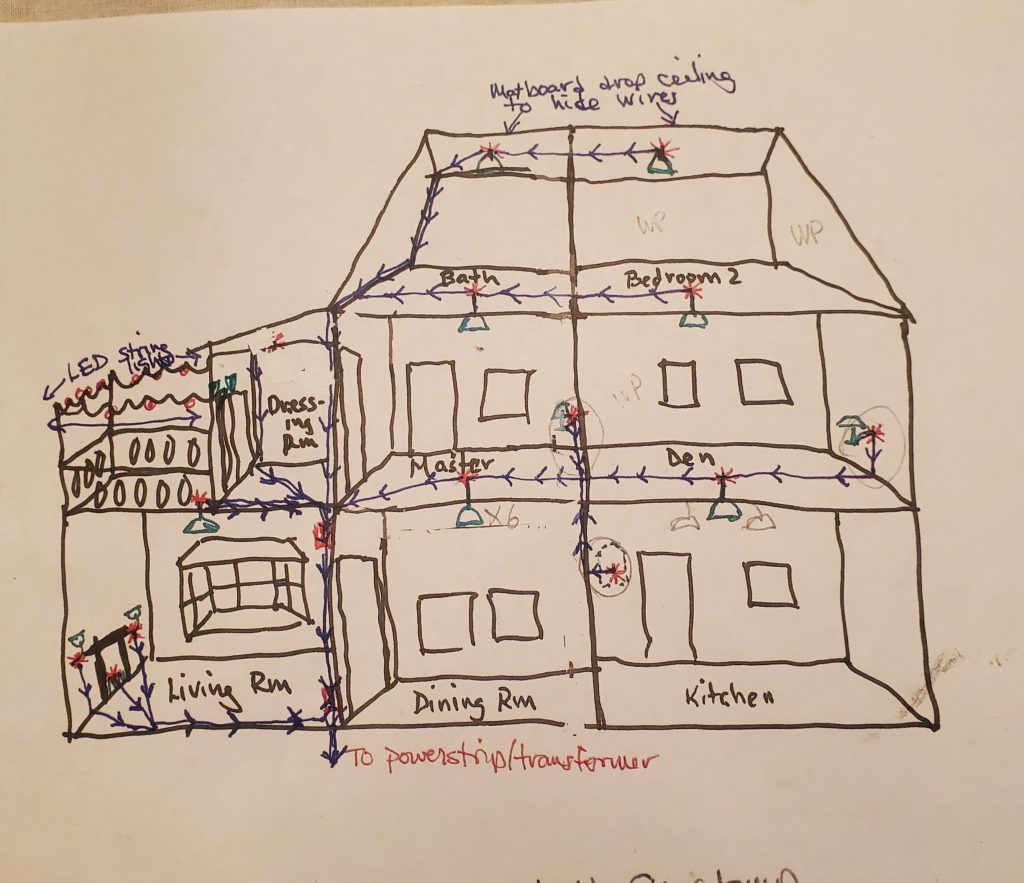
I really have to get busy with wiring, because it is holding up a lot of other processes. Below is my crazy wiring diagram, if you are interested. You can tell that I don’t have any hidden drawing talent. It probably only makes sense to me, because there is so much going on. The left addition will be wired separately from the right so the house can come apart. I want to make most of the light fixtures by hand. The red asterisks indicate where light fixtures will be. Most of the wires will be hidden by flooring or trim. I don’t want to use tape wire and with 3V LEDs I don’t have to. The wires needed are a very fine gauge so should be easy to hide.
More to come, but I can’t really promise soon – unless I win the lottery or something.

Take care! – Margie

Dollhouse upcycle project: Making 1:12 scale fancy bowls from discarded plastic spout rings

With a little effort and a few items, you can make these lovely porcelain-look bowls for your dollhouse. They will add such a realistic designer touch to a miniature China hutch, plate rail or dining room table.

What you will need:

  • Images of China plate patterns shrunk down to 1″ in diameter and printed on regular printer paper. The kind that has an outer boarder and center circle design with a band of white between them, not a pattern all-over
  • White or cream colored acrylic paint and a small paintbrush
  • Plastic ring tabs that are removed from a cardboard carton of coffee creamer or similar container
  • Sharp scissors for small detail work
  • Craft blade (optional)
  • White or tacky glue
  • Sandpaper or emery board
  • 1″ & 3/4″ circle hole punches (optional, but nice to have)
  • Gloss mod podge or clear glaze

First you need to prep the plastic rings by cutting the “bowl” part away from the ring. Carefully use a craft blade if you don’t want to dull your good scissors. Cut as close to the rim of the bowl as you can and then sand smooth any remaining bump left. If your plastic doo-hickey is like mine, there may be raised numbers on the bottom but these won’t show when you are done. You can try to sand them down too if they bother you. Then set the bowl level on your sandpaper or emery board and sand a flat spot on the base, so you bowl will sit level.

Next paint your bowl white or cream (whichever looks best with the plate pattern you have chosen). Give it 2 – 3 coats on the bottom and top, letting dry on each side before turning to paint the other.

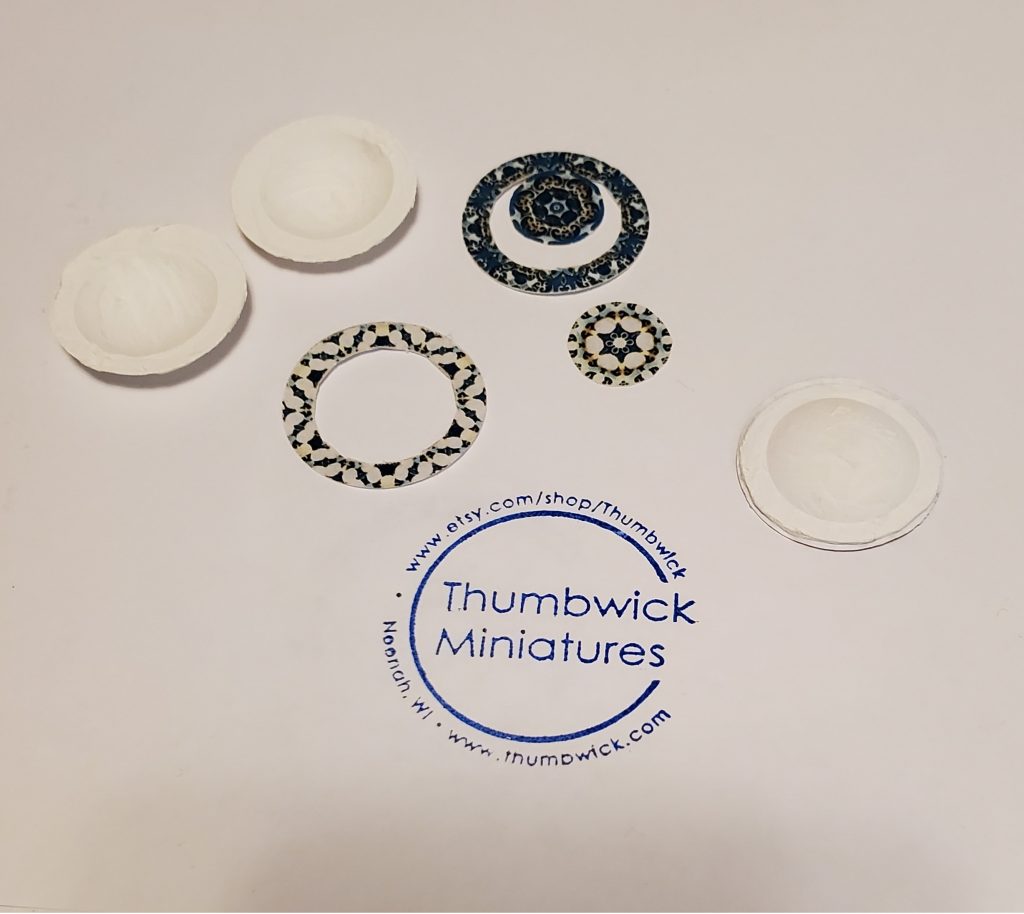
Now use your 3/4″ circle punch or scissors to carefully cut between the outer China plate pattern boarder and the center round pattern. Trim the center round pieces up to the pattern and set them aside for now. Use a 1″ circle punch to cut out the outer boarder patterns, or cut freehand with scissors, and trim the inner edge of the border up to the pattern. If you understood my explanation you should be left with outer circle shapes of the pattern with empty centers and inner circle shapes of the pattern. These will be glued to the painted plastic bowls. If you try to glue them without cutting the center and outer patterns apart and removing the white space between, you will end up with wrinkles, which you don’t want.

Spread a thin layer of glue on the back side of the center plate pattern and press it in the center of the bottom of the bowl. You will have a little time to move it slightly until it looks centered. Press it evenly into the curved shape in the bottom being careful to not make any wrinkles. Spread a thin layer of glue onto the back of the outer plate pattern ring and press it onto the rim of the bowl. The rim may not be exactly round, so eyeball the pattern ring up until it looks evenly spaced around the center pattern. This means it may hang slightly over the side of the plastic bowl in some spots. You can fill this underneath ridge in with gloss mod podge or clear glaze at the end so don’t worry about it. It’s much better to get it all centered correctly than to match the edges of the bowl, because you will mostly be looking at the front of the bowl, not the underside.

When you pattern is dry you can seal the whole dish with gloss mod podge or glaze using several coats on the bottom and top, leaving it just a little thicker on the underneath edges that are hanging over the bowl to even it up. Paint 2 – 3 coats on the bottom and top, letting dry on each side before turning to paint the other.

Make a whole set of matching bowls or make different coordinating patterns to go on a shelf together. You might want to make matching plates to go with the bowls. When making plates you won’t need to worry about wrinkles, so you don’t have to cut the centers out, just use something that is 1″/25mm across as a base. I haven’t tried it, but I have heard that you can make miniature plates out of the base of egg carton cups, so do a search on that technique if your goal is to upcycle (aka turn trash into treasure). And I think that is a very worthy goal, which is why I wrote this tutorial to begin with.

Have fun with it, improve on it and keep nurturing your tiny obsession, my friends!

I am FINALLY starting my Walmer dollhouse rebuild project.

I’ll be completely renovating this old 1960’s Walmer “knockdown” dollhouse into what I hope will be an amazing French Country style with a 2-story addition. When it is done, it will have European style casement windows, a large Bay window on the addition, two new dormer windows on the 3rd story, new doors and a completely new interior and exterior renovation. I’m practically building a new house (kind of like they do on that “Extreme Home Makeover” TV show, but without the bulldozer).

These dollhouses have an interesting history. I found this information from someone named Joanne on the Greenleaf forum: “Mr. Walmer made the knockdowns with the pegs, so children from military families could easily take apart their dollhouse and take it with them when they moved. He designed and obtained patents on the knockdowns.” Joanne says she actually talked to his daughter Lucy who told her the Walmer history. Mr. Walmer later sold his line to Real Good Toys and they sold them under the Lilliput name.

I’ve been a little torn as to whether I should keep the dollhouse able to be taken apart as originally intended, or to glue it together. Since I plan on adding round wiring for electrical, I think it best to glue it permanently together. I will compromise by keeping the new addition separate, so it is easier to box up or store the whole thing in the future if necessary.

I’m posting some pictures of the first stage, where I’m widening the window and door openings. I took the house apart, so I could cut the openings easier. I’ve tried using my scroll saw, which works great until I run out of room to move the piece back and can’t cut any further. The holes aren’t big enough to get a coping saw into, and my mini miter box razer saw has a ridge at the back which also prevents me from using it. I am forced to use a jig saw in some places, which I’d rather not do, as it isn’t the most delicate of tools. So far, the wood isn’t splintering or cracking, which is lucky.

I put the house back together to determine where the dormer windows would look best and get exact measurements for my addition. Eventually, I’ll take the whole house apart (again), which will make it easier to paint. I’ve also found that a wet sponge and putty knife works well for removing the old wallpaper.

I’ll be posting my progress in the coming weeks and months, so be sure to check back from time-to-time to see the dollhouse transform. Now, on to the pictures.

The house BEFORE:

Starting to enlarge the door and window openings. I’ve removed all the old doors, windows and trim. You can barely see the pencil mark I’ve made in the roof, which will be the opening for the left dormer.

I’ve also cut the first floor opening to the addition. There will be a door to the second floor soon. I was a little worried about putting such a large opening into a load-bearing wall, but I went for it. I’ll be framing the opening, which I hope will lend some support.

Double to singles: mini wood window conversion tutorial.

If you have double windows, but really need single windows for your dollhouse, you can convert them with just a pot of boiling water and some wood glue. Read on to find out how.

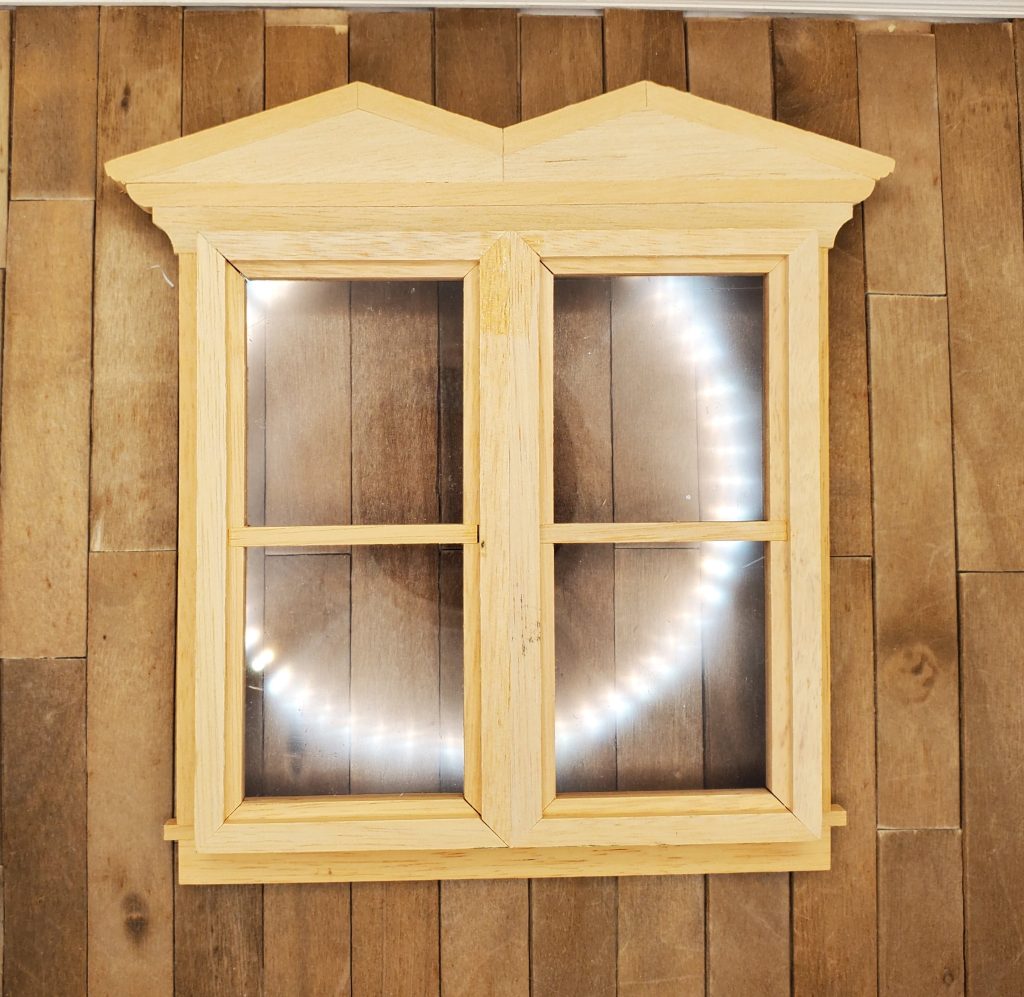
First you start with a basic unfinished wooden double window, like the ones I sell in my Etsy shop. You can use either working or non-working windows. This tutorial covers non-working windows, but the steps to convert working windows are very similar.

Looking at the back of this double window, you can see that it is really made of two single windows side by side. This is lucky for us! It makes creating two separate windows possible with minimal effort.

On to the tutorial!

Step 1: Get a pot of water boiling on the stove. You only need to bring it to a simmer, not a rapid boil. Use a pot large enough to completely submerge your double window.

Step 2: Slide the plastic windowpane inserts out of the windows and set them aside (they slide up and out the top slot of each window). Please don’t put these in the hot water. They will warp and possibly melt. Examine the window closely, so you will know how to reassemble the pieces. I suggest you take some pictures beforehand. It looks simple, but when all the pieces come apart, it’s not so easy to remember.

Step 3: Using tongs (not your hands) submerge the whole window (minus the panes) in the hot water and simmer for a few minutes. Watch the window the whole time. You want to remove it when the glue joints start looking white-ish. This means the glue is softening. Using tongs, pull the window out of the water and gently tug at the edges (wear dishwashing gloves to protect your hands from the heat). If it starts to fall apart, you are ready to start disassembling it. If not, put it back in the water for a bit. As you pull off pieces, you can keep some out, and put others back in the water to continue softening the glue. Don’t pull too soon, or you may split the wood. Also, try not to keep the wood in the hot water longer than necessary. In my experience the pieces won’t warp at all, if your window is made of good hardwood, but better safe than sorry.

Step 4: Allow all pieces to completely dry on a clean towel.

If you are lucky with timing, your window pieces will still be partially assembled when you remove them (like the one pictured on the left above). Then you won’t have to work so hard to reassemble them (like the one on the right which came completely apart).

Step 5: Reassemble the window parts with wood glue, to have two windows instead of one. You want to use only the pieces pictured above. When dry, slide the windowpane back in the top slot. You may also want to stain or paint your windows before doing this.

You will be left with many pediment, sill and trim pieces, as well as interior trim and mullion pieces that came with the window. With a few miter cuts of the exterior trim pieces (there should be 3 vertical outer pieces, and 5 interior pieces), you will have enough trim to frame both windows on the outside, with pieces to spare. You may also find some creative things to do with the leftover pediment, sill and trim (think shelf, mantelpiece and picture frame for starters).

I hope you have enjoyed this tutorial and find it useful.

Have a happy mini-making day!

-Margie

Miniature 1:12 Scale Pink Yard Flamingos for Dollhouse or Fairy Garden

I sell the miniatures I make on my Etsy site, and one of my most popular items is my miniature pink yard flamingos. I can’t keep up with the demand, so they are always selling out.

Miniature 1:12 Scale Pink Yard Flamingos by Thumbwick Miniatures

They are extremely realistic looking and adorable, if I may say so myself. They are also time consuming to make. I know that I am never going to have a business that pays the bills by selling just them. OK, theoretically, I probably could make about 30 an hour, if I really push it, and do that four hours a day, leaving the rest of my time to actually run my business. Then, assuming they all sold, after expenses, I could actually make enough money to comfortably live on. Very soon though, I would get really tired of making tiny yard flamingos. Making a couple dozen is really run and rewarding, but making thousands of them would be torturous.

So, I decided to create a miniature pink yard flamingo kit to also sell on my Etsy site, for crafty, creative people who would also find it fun to make them. This would also make them more affordable for people, because I don’t have to charge for my own time to paint their tiny beaks and eyes, and attach their metal legs. If someone only has to buy the kit and then invest their own time, then there are more practical uses for the tiny flamingos. They become affordable party favors, stocking stuffers and gift toppers. If the paint is sealed with varnish to make them waterproof, then they can even be washed and used as cake and cupcake decorations.

Miniature 1:12 Scale Pink Yard Flamingos Kit makes 12

When I buy a kit, I like everything I need to be included, so I don’t have to run out and buy this or that additional item. I tried to include everything one would need, but to include a pair of scissors or pliers would make the kit too expensive. I also think most people already own those items. I documented the process very thoroughly with pictures to create instructions which I hope are detailed, yet easy to follow.

Painting the tiny flamingo beaks in yellow

If you do happen to buy my kit, please let me know what you think about it. I’m always trying to improve, so feedback is always welcome.


Miniature 1:12 Scale Pink Yard Flamingos – one pink and one hot pink

Thanks for reading!

Margie