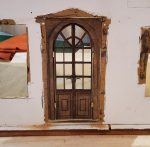
French style split arch wooden 1:12 scale door

I just have not found the time to do much with my Walmer dollhouse rebuild lately, but I did make some design decisions. I designed an impressive new front door to replace the mass-produced version I was going to use. I think it will give it more of a European flair. I used pictures of full-sized split arch French style doors to create a pattern. Then I had fellow Etsy seller ShedtoshelfBySean produce it for me. I really like how it turned out.

After some staining, gluing with clear plastic sandwiched between the doors for windowpanes, hinges, fancy door handles and a lot of cutting and sanding to make it fit, I finally got the door that I want. I plan to build a small overhang above the door to create a portico and make it more inviting.

I also practiced my stonework technique and decided on stone and mortar colors. The “stone” is made from torn pieces of paper egg carton. The pieces I used for practice are larger than what I will use on the exterior walls of the dollhouse. I glued the pieces to a painted piece of cardboard. Then I tried various colors and techniques for the stone and mortar. I’ve decided to go with the one on the left in the picture below. It is a custom blended mortar color, FolkArt chalk paint in the shade of Sheepskin (ugh, I don’t like the name) with a very watered-down wash of Rust-oleum Chalked Smoked Glaze. The stones next to them have a wash of Chalked Aged Glaze, but I like the gray look of the smoked better. I will finish with a sealer, but I haven’t decided between Mod Podge matte or a matte artist spray sealer yet. I’ll have to do a test to see which looks better.

I will be much more careful with the mortar color when I do the finished product, I was just being sloppy with my test because I got tired of trying different colors.

The other decision I made was to use split cedar shakes for the roof. I’ve been hemming and hawing over that because I wanted to do a metal roof, but I just don’t have any experience with that and am not confident that it would turn out well. I’d rather go with an “aged” wood shingle look, because I have worked with that before. I wasn’t really sure if cedar shakes are usually done on a mansard roof, but I found out it is fairly common. I found this picture, which is most likely the look I would get, except I could apply a grey wash to age it:

Then I saw THIS, and it really makes me want to go with the fish scale shingles. It also makes me want to add the extra ridge at the bottom so that I can add corbels. And this is why my project is taking so long…

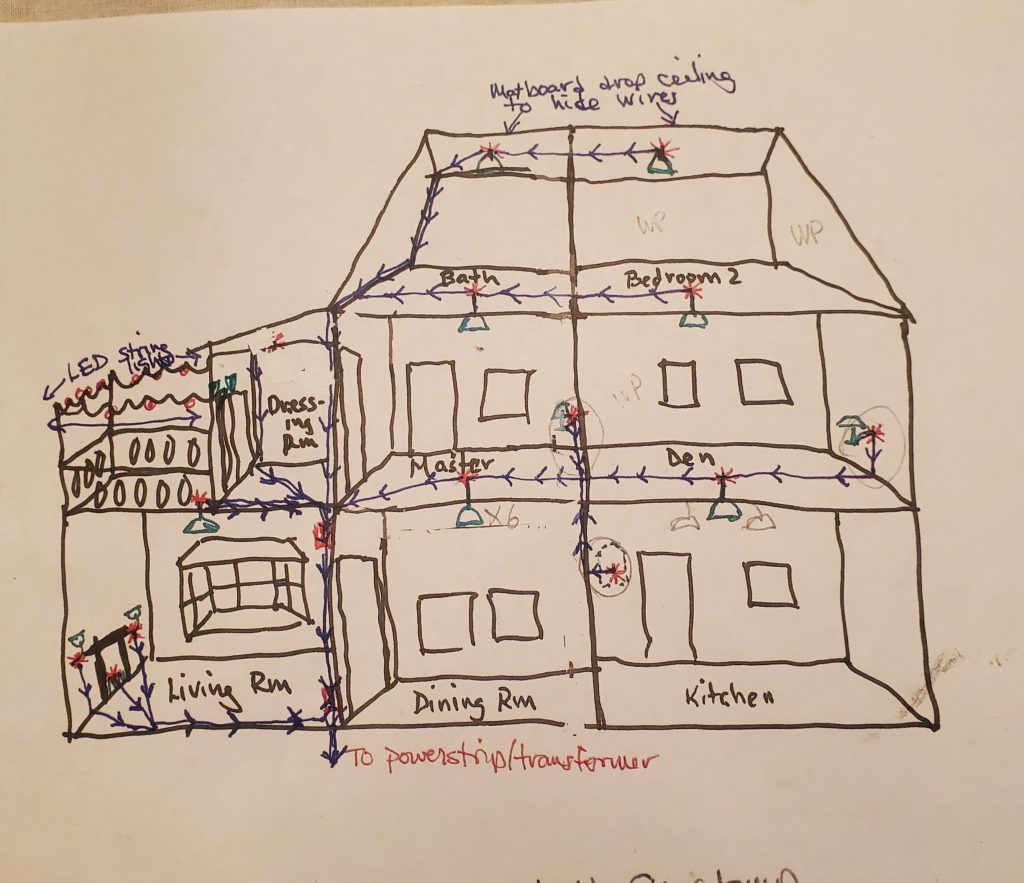
I really have to get busy with wiring, because it is holding up a lot of other processes. Below is my crazy wiring diagram, if you are interested. You can tell that I don’t have any hidden drawing talent. It probably only makes sense to me, because there is so much going on. The left addition will be wired separately from the right so the house can come apart. I want to make most of the light fixtures by hand. The red asterisks indicate where light fixtures will be. Most of the wires will be hidden by flooring or trim. I don’t want to use tape wire and with 3V LEDs I don’t have to. The wires needed are a very fine gauge so should be easy to hide.
More to come, but I can’t really promise soon – unless I win the lottery or something.

Take care! – Margie

Shabby French style Walmer dollhouse rebuild – part 2

If you are just joining my rebuild project, you can start with part 1 here.

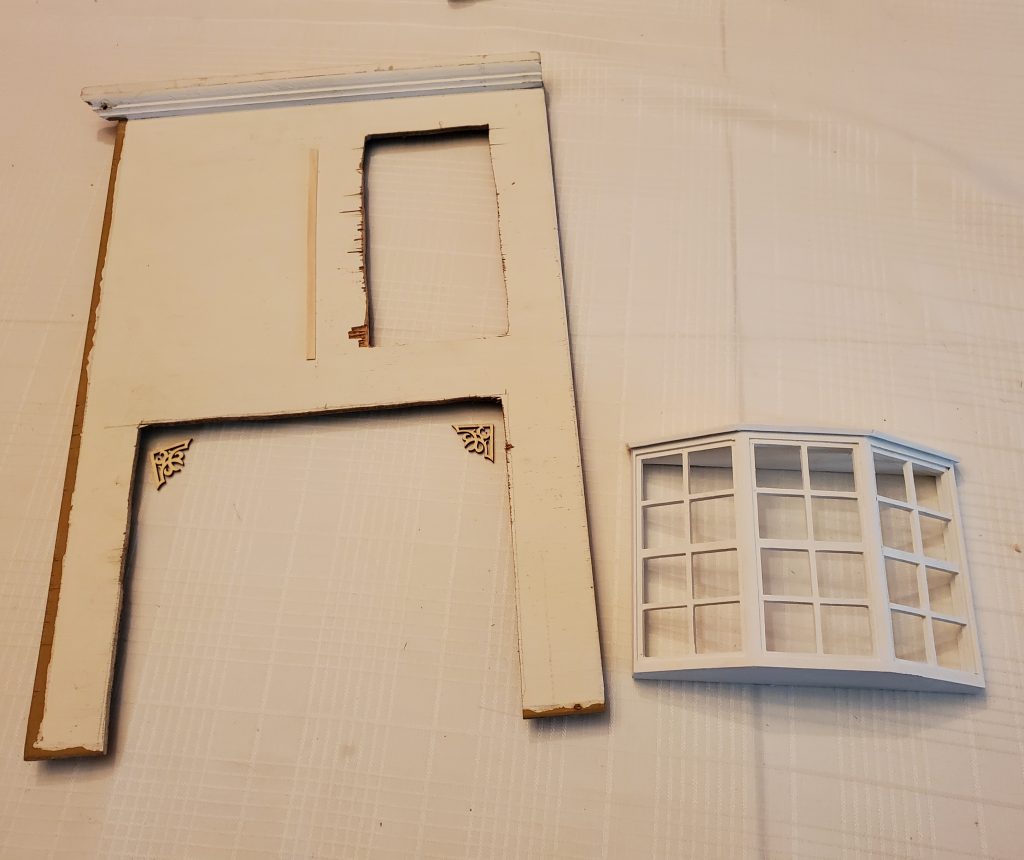
I’ve made progress on widening the window openings and added a second-floor doorway that will go to the new addition. Unfortunately, there was some splintering of the wood when I cut this, so I will have to do a little wood filler in places. I will also frame in this doorway – coffee stir sticks seem to be the correct width, so they will work to frame in and square off the openings. Door and window trim can cover any gaps, and leave a nice, finished look. This doorway won’t have an actual interior door, because it leads to a small sitting room off the master bedroom. This room will have French doors that lead to the second story terrace (I wanted to say balcony, but terrace just sounds classier).

I think the little laser cut wood corbels that I have will add a nice decorative touch in the upper corners of the lower archway, once it is framed in and squared off. Here is a picture of the openings in the wall. Next to that you can see the bay window that is already painted and waiting for the addition I haven’t built yet.

I test-fitted some of the windows and doors which I have already painted. I also made dormers for the roof openings. Getting the angles on the roof pieces was pretty tricky and a lot of trial and error. My husband suggested that I use “geometry” to figure it out, but that just sounded like it would take all the fun out of it.

I found this great metal ribbon (I think it is also sometimes called lamp band) with the correct width to replace the lattice on the small balcony. I will cut short pieces for the ends also and run a painted wood railing along the top. I also think I’ll add a couple window boxes on the front railing, for some greenery and flowers. I want to add some window boxes elsewhere too but haven’t decided where yet. That same metal ribbon will also go around the second-story terrace on the addition and the roof terrace of the main house. This will create even more space for gardens and greenery.

I still have more work to do removing old wallpaper, and then I will get to cutting the pieces for new the addition.

I am FINALLY starting my Walmer dollhouse rebuild project.

I’ll be completely renovating this old 1960’s Walmer “knockdown” dollhouse into what I hope will be an amazing French Country style with a 2-story addition. When it is done, it will have European style casement windows, a large Bay window on the addition, two new dormer windows on the 3rd story, new doors and a completely new interior and exterior renovation. I’m practically building a new house (kind of like they do on that “Extreme Home Makeover” TV show, but without the bulldozer).

These dollhouses have an interesting history. I found this information from someone named Joanne on the Greenleaf forum: “Mr. Walmer made the knockdowns with the pegs, so children from military families could easily take apart their dollhouse and take it with them when they moved. He designed and obtained patents on the knockdowns.” Joanne says she actually talked to his daughter Lucy who told her the Walmer history. Mr. Walmer later sold his line to Real Good Toys and they sold them under the Lilliput name.

I’ve been a little torn as to whether I should keep the dollhouse able to be taken apart as originally intended, or to glue it together. Since I plan on adding round wiring for electrical, I think it best to glue it permanently together. I will compromise by keeping the new addition separate, so it is easier to box up or store the whole thing in the future if necessary.

I’m posting some pictures of the first stage, where I’m widening the window and door openings. I took the house apart, so I could cut the openings easier. I’ve tried using my scroll saw, which works great until I run out of room to move the piece back and can’t cut any further. The holes aren’t big enough to get a coping saw into, and my mini miter box razer saw has a ridge at the back which also prevents me from using it. I am forced to use a jig saw in some places, which I’d rather not do, as it isn’t the most delicate of tools. So far, the wood isn’t splintering or cracking, which is lucky.

I put the house back together to determine where the dormer windows would look best and get exact measurements for my addition. Eventually, I’ll take the whole house apart (again), which will make it easier to paint. I’ve also found that a wet sponge and putty knife works well for removing the old wallpaper.

I’ll be posting my progress in the coming weeks and months, so be sure to check back from time-to-time to see the dollhouse transform. Now, on to the pictures.

The house BEFORE:

Starting to enlarge the door and window openings. I’ve removed all the old doors, windows and trim. You can barely see the pencil mark I’ve made in the roof, which will be the opening for the left dormer.

I’ve also cut the first floor opening to the addition. There will be a door to the second floor soon. I was a little worried about putting such a large opening into a load-bearing wall, but I went for it. I’ll be framing the opening, which I hope will lend some support.